
Independent UK Compound Guide
Retatrutide
Independent information on how Retatrutide works, what clinical trial research shows so far, common side effects, dosing and its current development status.
Slim Shots is an independent educational resource. Retatrutide is an investigational compound and does not currently hold MHRA or EMA marketing authorisation. This page does not replace advice from a doctor, pharmacist or other qualified healthcare professional.
Retatrutide Explained
What Is Retatrutide?
Retatrutide is a compound that acts on three hormone pathways: glucose-dependent insulinotropic polypeptide (GIP), glucagon-like peptide-1 (GLP-1) and glucagon (GCG) receptors. It is often described as a "triple agonist" because of this three-pathway mechanism.
These pathways are involved in appetite, fullness, blood-glucose regulation and energy expenditure. Retatrutide has been studied in clinical trials for weight management and, separately, for markers of liver fat and metabolic health.
Retatrutide is currently investigational. It does not yet hold marketing authorisation from the MHRA or EMA and is not available as a licensed prescription medicine in the UK.
Mechanism of Action
How Does Retatrutide Work?
Retatrutide is described as a triple agonist because it acts on GIP, GLP-1 and glucagon receptors simultaneously.
Appetite and Fullness
Activity at GLP-1 and GIP receptors can affect appetite and help some people feel full after eating less food.
Energy Expenditure
The additional glucagon receptor activity is thought to contribute to increased energy expenditure and hepatic fat metabolism, distinguishing Retatrutide from dual or single-agonist compounds.
Blood-Glucose Regulation
GIP and GLP-1 pathway activity is also involved in insulin and glucagon responses relevant to blood-glucose regulation, which has been studied in trial participants with type 2 diabetes.
Product Imagery
Retatrutide Vial
Retatrutide remains an investigational compound. Product appearance, presentation and instructions may vary. This image is shown for identification purposes only.
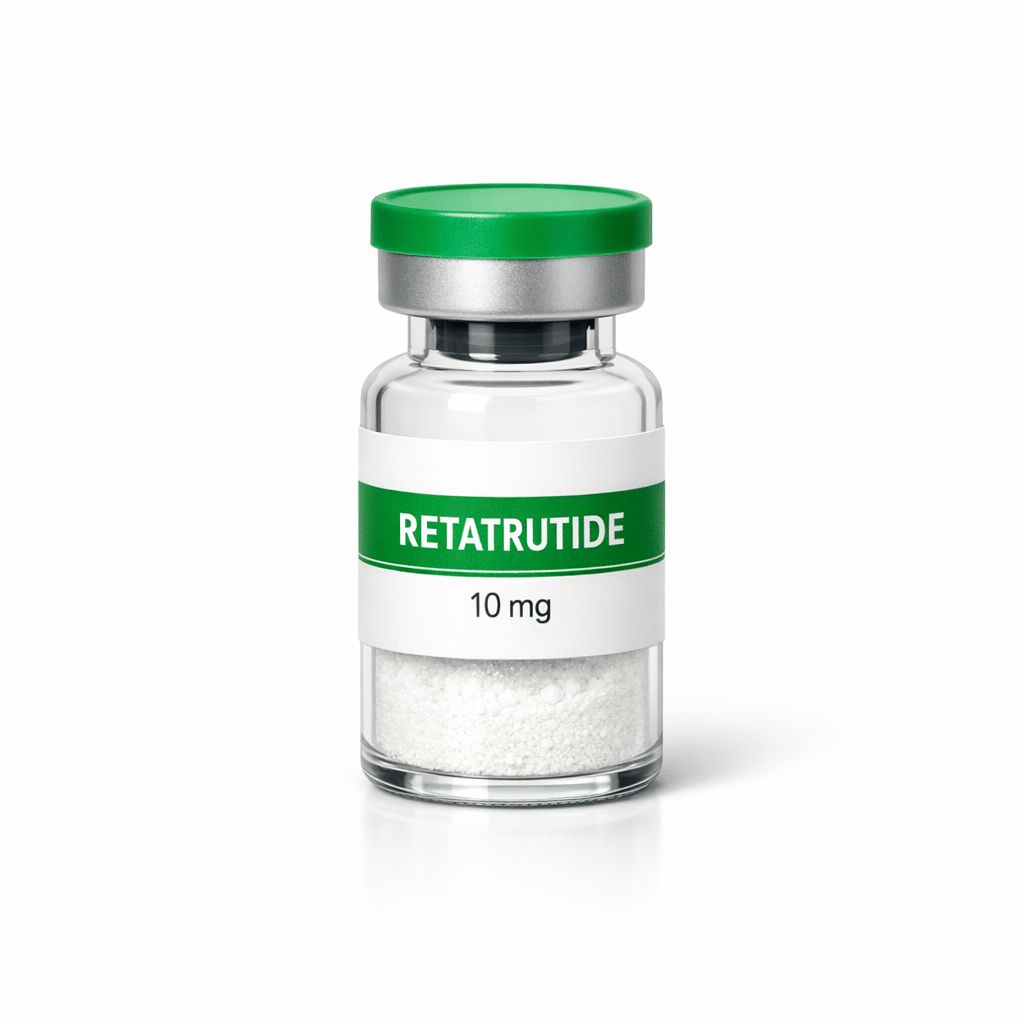
Retatrutide
Investigational compound presentation
Clinical Research
What Does Retatrutide Research Show?
Results differ between trial participants and are affected by dose, trial duration, baseline weight, nutrition, activity and individual health factors. Trial averages should never be treated as guaranteed individual outcomes.
In the phase 2 trial published in the New England Journal of Medicine, adults with obesity receiving the highest studied dose of Retatrutide (12 mg) had an average body-weight reduction of approximately 24.2% over 48 weeks, compared with around 2.1% in the placebo group.
Later-stage trials in the ongoing phase 3 programme have reported further results across different populations, including people with obesity, type 2 diabetes and cardiovascular risk factors. A qualified healthcare professional or the primary published trial data should always be consulted for the most current and complete picture.
Phase 2 Trial (NEJM, 2023)
24.2%
Average body-weight reduction over 48 weeks
Reported for participants receiving Retatrutide 12 mg in the phase 2 obesity trial. Individual results can vary substantially and later phase 3 trials have reported different figures across populations.
Product Context
Retatrutide vs Other GLP-1 Compounds
Retatrutide's triple-receptor mechanism is a key difference from single or dual-agonist compounds. Development stage and regulatory status also differ significantly.
| Topic | Retatrutide | Important Context |
|---|---|---|
| Receptor targets | GIP, GLP-1 and glucagon (triple agonist) | Differs from Semaglutide (GLP-1 only) and Tirzepatide (GIP and GLP-1). |
| Regulatory status | Investigational; phase 3 trials ongoing/completed | Not yet approved by the MHRA or EMA. A regulatory submission has not yet resulted in approval. |
| Dosing and delivery | Once-weekly subcutaneous injection in studied trials | Dosing schedules in trials have used gradual dose-escalation over several weeks. |
| Suitability | Assessed individually | As an investigational compound, use outside a clinical trial setting carries additional uncertainty. |
Retatrutide FAQs
Frequently Asked Questions About Retatrutide
Clear answers to common questions about Retatrutide, including its mechanism, trial results, side effects and current availability.
What is Retatrutide?
Retatrutide is an investigational compound that acts as a triple agonist on GIP, GLP-1 and glucagon receptors. It has been studied in clinical trials for weight management and, in a substudy, for liver fat reduction.
Is Retatrutide available on prescription in the UK?
No. Retatrutide does not currently hold MHRA or EMA marketing authorisation and is not available as a licensed prescription medicine in the UK. It remains investigational.
How is Retatrutide different from Semaglutide and Tirzepatide?
Semaglutide acts on the GLP-1 receptor alone. Tirzepatide acts on GIP and GLP-1 receptors. Retatrutide adds a third pathway, glucagon receptor activity, which is thought to relate to increased energy expenditure and hepatic fat metabolism in addition to appetite and fullness effects.
How much weight loss has Retatrutide shown in trials?
In the phase 2 trial published in the New England Journal of Medicine, participants receiving the 12 mg dose had an average body-weight reduction of approximately 24.2% after 48 weeks. Later phase 3 trials in different populations have reported other figures. These are trial averages, not guaranteed individual outcomes.
How often is Retatrutide injected in clinical trials?
In published trials, Retatrutide has been administered as a once-weekly subcutaneous injection, with gradual dose escalation used to help with tolerability.
What are the common side effects reported with Retatrutide?
The most commonly reported side effects in trials have been gastrointestinal, including nausea, vomiting, diarrhoea and reduced appetite. These were generally dose-related and mostly mild to moderate. A dose-dependent increase in heart rate has also been observed in trial data.
Has Retatrutide been studied for anything other than weight loss?
Yes. A substudy of the phase 2 trial assessed liver fat in participants with metabolic dysfunction-associated steatotic liver disease (MASLD), reporting substantial reductions in liver fat at higher doses. This remains an area of ongoing research rather than an approved use.
When might Retatrutide become available in the UK?
Retatrutide's developer has progressed the compound through phase 3 trials, with a regulatory filing anticipated in future. Until a licence is granted by the MHRA, Retatrutide remains investigational and is not approved for prescription in the UK. Timelines can change and should be checked against current regulatory announcements.
Is it safe to obtain Retatrutide outside a clinical trial?
As an unlicensed, investigational compound, the safety, quality and authenticity of products obtained outside authorised clinical trials or regulated routes cannot be assured. Anyone considering Retatrutide should seek guidance from a qualified healthcare professional.
Safety and Suitability
Retatrutide Remains Investigational
Retatrutide has not completed the regulatory process required for a UK marketing authorisation. Long-term safety data outside of trial settings has not been fully established.
Only use medicines or compounds obtained through an appropriate regulated route. If you experience a suspected side effect, speak to a healthcare professional. In the UK, suspected side effects can also be reported through the MHRA Yellow Card scheme.
Keep Exploring
Related Compound Information
Explore more independent information on GLP-1 and related compound topics.
Tirzepatide Guide
Learn about Tirzepatide, a dual GIP/GLP-1 receptor agonist and the active ingredient in Mounjaro®.
EXPLORE TIRZEPATIDE →Semaglutide Guide
Learn about Semaglutide, a GLP-1 receptor agonist and the active ingredient in Wegovy® and Ozempic®.
EXPLORE SEMAGLUTIDE →Expert Advice Hub
Browse science-led information on GLP-1 compounds, research and commonly asked questions.
EXPLORE EXPERT ADVICE →GLP-1 Information
Read general educational information about GLP-1 compounds and product-specific instructions.
READ THE GUIDE →General GLP-1 FAQs
Find answers to broader questions about GLP-1 compounds, research and information covered by Slim Shots.
VIEW ALL FAQS →Latest Articles
Read the latest Slim Shots educational articles about GLP-1 medicines and compound comparisons.
VISIT THE BLOG →Further Reading
Retatrutide Information Sources
- Clinical trial evidence: Jastreboff AM et al. Triple-Hormone-Receptor Agonist Retatrutide for Obesity — A Phase 2 Trial, New England Journal of Medicine (2023).
- Liver fat substudy: Sanyal AJ et al. Triple hormone receptor agonist retatrutide for metabolic dysfunction-associated steatotic liver disease, Nature Medicine (2024).
- UK medicine and safety information: UK Medicines and Healthcare products Regulatory Agency (MHRA) and ClinicalTrials.gov trial registrations.
Retatrutide Information
View Retatrutide Options
Review available Retatrutide information and understand the importance of professional medical assessment before making a health-related decision.
VIEW RETATRUTIDE OPTIONS →